His Bloody Project

A friend loaned me this book by Graeme Macrae Burnet a while ago, and I finished it yesterday. It is an interesting and troubling novel about murder in the Wester Ross area of Scotland in the late 19th century. Right from the start you know who did it, as the whole first section of the book is a written narrative by the murderer describing his life, family, village, and the circumstances leading up to the three murders. He freely states his guilt in this matter.

After his narrative, there is a section on the medical reports with the big question being the murderer’s sanity, and then the trial. Although there is a particular inevitability in the whole book, the story is compelling and there is enough intrigue to hold your attention. And the writing is very good, especially the murderer’s narrative. The author did an exceptional job writing with the language and patterns of the time. As the protagonist is Roderick Macrae, one almost wonders if there is a link. But is this indeed fiction.

https://images-na.ssl-images-amazon.com/images/I/51tx30BCH7L._SX321_BO1,204,203,200_.jpg

This book was short-listed for the Man Booker prize is 2016. I’ve always been intrigued by this prize, as I often like the books selected as the finalists and the winners. This year’s short list was just announced, so I’ve decided to try to read them all before the winner is announced on October 17. Well, except for the one titled 4321 because it has 900 pages!

Here’s a link to this year’s shortlist:http://themanbookerprize.com/news/man-booker-prize-announces-2017-shortlist

Sherman Alexie

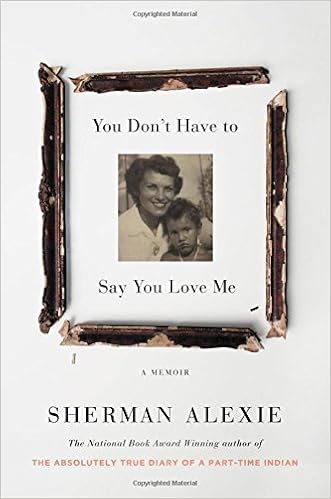
A few days ago I finished Sherman Alexie’s memoir, You Don’t Have to Say You Love Me. It is an amazing and powerful book, mostly about his memories and experience of his mother, a member of the Spokane Tribe. She was a maker of quilts, and the book itself is a quilt of story, grief, and anger in sections of narration and poetry. Alexie, as he does in all his writings, draws us into the difficult and painful complexities of the history and present of our indigenous sisters and brothers and our relationship to all of that, and helps us laugh with him and at ourselves along the way. His own story of moving away from the “rez” is a strong one, but I came away wanting the “rez” life to be equally as strong and feeling his deep sorrow that it is not. He is a wonderful writer, so all the poems and narration are clear and beautiful even when the truth of the story is hard to absorb. And there are many parts that are emotionally hard to read in this book.

There are multiple ways in which we white people of privilege can find some pathway into our racism, and this book is one small way to think seriously about all of that. But Alexie’s book tells of the powerful force of racism in every culture, even Indian to Indian and Indian to white folk. Dealing with racism is a common topic in our culture right now, from many perspectives, and it should be. But this memoir, at least for me, has helped think about that for myself in new and profound ways. I am grateful to Alexie for allowing us this look into his life that helps us look well into our own.

But this book is mostly about grief, about his grief for his often difficult mother, for the loss of so much all the time on the reservation, for the loss of ways of life, and the gift of salmon. In a chapter entitled “Harvest,” Alexie writes about going to the funeral of one of his white high school classmates who was killed in a car wreck. My entire class, all fifty of us, went to Donny’s funeral. I sat in a back pew and cried for a while. I liked Donny. I would miss him. He died so young . And because I’d already been to a dozen wakes and funeral, it felt as if all of the separate grief had become one ever-growing grief, as if each grief was worse than the previous grief because of exponential math. So it felt like my grief for Donny was the same size as all the rest of my grief combined, plus one. But I stopped crying when I noticed that very few people were being openly emotional. I’d never seen that many stoic people at a funeral. I’d never experienced a silent and polite funeral. My tribe doesn’t bury our dead that way. We wail, weep, and tell dirty jokes at graveside. … That was the first time I truly understood that I was a foreigner. I might have been indigenous to the land I itself, but I was a first generation cultural immigrant to the United States. I was now living in a place where people did not grieve like me. Later, back at school, I was even more shocked to learn that it was the first funeral that most of my classmates had attended. Donny Piper was their first death. I thought they were kidding. But, no, it was true. My white classmates knew very little about death. We didn’t keep a tally, but based on the stories I remember from that day, I think I might have attended more funerals than all of my white classmates put together. [Sherman Alexie, You Don’t Have to Say You Love Me, Little Brown and Company, New York, June, 2017. p. 217]

Often memoirs ask for the reader’s applause. This one asks for our participation, as we are invited into Alexie’s life and grief and journey.

https://images-na.ssl-images-amazon.com/images/I/41%2Bo9MxhaTL._SX329_BO1,204,203,200_.jpg

Inklings, Part 2

There were many people who wandered in and out of the Inklings conversation, including Dorothy L. Sayers (who one writer called a “para-Inkling,”) but the the core group was Tolkien, Lewis, Williams, and Owen Barfield. Barfield was an attorney and also an adherent of the anthroposophical ideas of Rudolf Steiner (the Waldorf Schools arose from his thought about creativity). Steiner’s philosophy and his emphasis on creative imagination was attractive to them all. Barfield was its biggest proponent, and was a member of The Anthroposophical Society.

In a review of a 1996 documentary about Barfield (Owen Barfield: Man and Meaning), reviewer Dale Nelson writes: Many people who look into the writings of Owen Barfield, … are C. S. Lewis admirers who are curious about this man who was Lewis’s close friend throughout his adult life, from 1919 until Lewis’s death in 1963. Barfield was Lewis’s legal and financial advisor, and he became an executor of his estate. Lewis dedicated his first scholarly book, The Allegory of Love (1936) to this “wisest and best of my unofficial teachers,” stating in its preface that he asked no more than to disseminate Barfield’s literary theory and practice. He also dedicated the first Narnian chronicle to his friend’s adopted daughter Lucy. In his autobiography, Surprised by Joy, Lewis portrayed Arthur Greeves as the First Friend, who reveals that one is not alone in the world in one’s imaginative outlook, and Barfield as the Second Friend, the one who never fails to challenge and to prod one to new understanding.

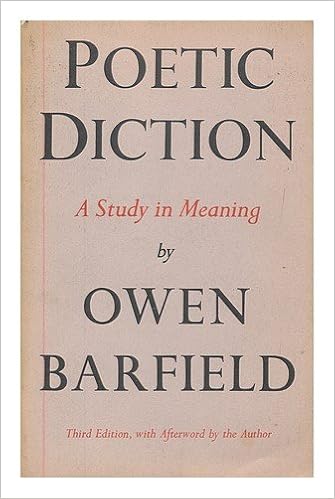
Barfield wrote several very interesting books, including Poetic Diction, which includes the key thinking that so interested Lewis and the others. Nelson writes: Barfield’s thought is always characterized by the conviction that the humanities matter very much indeed, for all of us—not only for professional academics. Poetic Diction, along with Lewis’s Experiment in Criticism and Tolkien’s “On Fairy-Stories,” will reward anyone needing assurance of the value of literary experience. Poetry, Barfield shows, can provide a “felt change of consciousness”—experiencing a single line of poetry, one may from that moment know more, though what is known is not a matter of “fact.” Poetic Diction (1928), dedicated to Lewis, is Barfield’s most extended treatment of this insight.

The broad scope of thinking of Lewis and Tolkien and their friends is often overlooked, especially by those who would like to lock Lewis’ thinking into a narrow, dogmatic cage. These friends talked together, and together they shaped the thinking out of which would come wonderful and articulate volumes of faith and wonder. I am always intrigued to think about the amazing conversations they must have had sitting in the corner at the Bird and Baby.  Barfield’s dedication to Lewis in Poetic Diction says this: “Opposition is true friendship.”

Reading Barfield isn’t exactly an easy undertaking, but it is worth the effort, especially if you’re interested in delving more deeply into the back stories and thinking of Lewis and Tolkien.

https://images-na.ssl-images-amazon.com/images/I/51nkXXsmYsL._SX333_BO1,204,203,200_.jpg

Another interesting Inkling conversation partner is Bede Griffiths. He became a Roman Catholic and then a Benedictine monk. When his order sent him to India, he became deeply connected to Hinduism. He worked through these Hindu/Christian connections for his lifetime. He had left his original order after being in India for a while, but then he found a home in the Camaldolese Benedictines. His works are preserved at the New Camaldoli Hermitage in Big Sur, California. It’s a very lovely place. Find out more here: https://contemplation.com/

Dale Nelson review: http://www.touchstonemag.com/archives /article.php?id=11-03-036-b (accessed September 14, 2017).

Glass Houses

I finished the latest Louise Penny novel, Glass Houses, a couple days ago. I think it is her best one yet. She uses two interesting motifs. One is a Spanish debt-collector called a Cobrador del Frac. The other is a quote from Gandhi: “There is a higher court than courts of justice and that is the court of conscience. It supercedes all other courts.” Her use of conscience at all levels throughout the book is really masterful, I think. Each character struggles with his or her own conscience, and there is excellent dialogue around conscience and telling the truth. I don’t want to say much more. You need to read the book – assuming you’ve read the 12 that come before it!

This is a quick post today. Still at Holden and haven’t had good time to do the next Inklings post. Stay tuned for the very interesting Owen Barfield, who C. S. Lewis called one of his most significant friends.

Inklings, Part 1

I’m spending a few days at Holden Village. My husband is the director of the museum here, and I’ve been very involved since I was on volunteer staff for the first time in 1971. It’s a pretty amazing place. You can learn more about Holden at www.holdenvillage.org.

Holden is the place where I first learned to appreciate the Inklings. This was the group of friends who, in mid-20th century Oxford, met together to talk literature, the myths of the North, and theology. They met once or twice a week at a pub named the Eagle and the Child – or the Bird and the Baby, as it was fondly known. You can visit this pub in St. Giles Street and see the plaque in the corner where they all met and smoked their pipes and talked. The most famous of the group, J. R. R. Tolkien, and C. S. Lewis, read chapters from their soon to be wildly popular The Hobbit and The Lord of the Rings Trilogy and The Chronicles of Narnia. I’d like to write about a couple of the lesser known members of their conversation group.

Charles Williams was an interesting, and somewhat eccentric, scholar, lexicographer, theologian, and novelist. He his best known for being one of the first editors of the modern edition of the Oxford English Dictionary. He was a curious intellect, looking for new perspectives and pathways from the ancient traditions of Christianity. He was keenly focused on love, especially romantic love, and looked for its manifestation in the fondational tenets of the faith.

One of his keenest insights came from one verse in Paul’s letter to the Galatians: Bear one another’s burdens, and in this way you will fulfill the law of Christ. (Galatians 6:2) He wrote about this verse in many ways and kept coming back to it. He called it “the way of exchange” and saw it as fundamental to how Christians should live out their faith. Essentially, it means that if I have a task to do, that is mine. No one can do it for me. If I am anxious about that task, that anxiety is the burden I bear. But if I give that anxiety to you – through prayer, or thought, or the simple exchange of emotion – you can bear it because the task isn’t yours, hence the anxiety about the task isn’t yours. I saw this work in a remarkable way here at Holden Village in 1977. A member of the staff wanted to speak at Vespers, but she was so anxious about public speaking she often broke out in hives. Another member of the staff (who I’m sure was never anxious about anything) prayed with this young woman before her Vespers. The young woman didn’t even break out in a rash, but her friend broke out in hives! (I know. I was sitting next to her.) She had never had hives, and they disappeared again the minute the talk was complete. An amazing, and, I admit, extreme, example of the way of exchange.

Williams wrote a handful of very unusual novels. One that deals specifically with this concept is called Descent into Hell (1937). In it the protagonist, a young woman in a play, keeps meeting her Döppelganger (an old German legend about seeing your double coming towards you) as she walks along. Here is a section from Williams’ novel where the play director Stanhope explains how the way of exchange can work:

“I know,” Stanhope said. “It means listening sympathetically, and thinking unselfishly, and being anxious about, and so on. Well, I don’t say a word against all that; no doubt it helps. But I think when Christ or St. Paul, or whoever said bear, or whatever he Aramaically said instead of bear, he meant something more like carrying a parcel instead of someone else. To bear a burden is

“I know,” Stanhope said. “It means listening sympathetically, and thinking unselfishly, and being anxious about, and so on. Well, I don’t say a word against all that; no doubt it helps. But I think when Christ or St. Paul, or whoever said bear, or whatever he Aramaically said instead of bear, he meant something more like carrying a parcel instead of someone else. To bear a burden is precisely to carry it instead of. If you’re still carrying yours, I’m not carrying it for you – however sympathetic I may be. [And anyhow there’s no need to introduce Christ, unless you wish.] It’s a fact of experience. If you give a weight to me, you can’t be carrying it yourself; all I’m asking you to do is to notice that blazing truth. It doesn’t sound very difficult.”

“And if I could,” she said. “If I could do –whatever it is you mean, would I? Would I push my burden on to anybody else?”

“Not if you insist on making a universe for yourself,” he answered. “If you want to disobey and refuse the laws that are common to us all, if you want to live in pride and division and anger, you can. But if you will be part of the best of us, and live and laugh and be ashamed with us, then you must be content to be helped. You must give your burden up to someone else, and you must carry someone else’s burden. I haven’t made the universe and it isn’t my fault. But I’m sure that this is a law of the universe, and not to give up your parcel is as much to rebel as not to carry another’s. You’ll find it quite easy if you let yourself do it.”

“And what about my self-respect,” she said.

He laughed at her with a tender mockery. “O, if we are of that kind!” he exclaimed. “If you want to respect yourself, if to respect yourself you must go clean against the nature of things, if you must refuse [God] in order to respect yourself, though why you should want so extremely to respect yourself is more than I can guess, go on and respect. [Must I apologize for suggesting anything else?”

[Charles Williams, Descent Into Hell, William B. Eerdman’s Publishing Co, 1990, pp. 98-9.]

Williams other novels are:
War in Heaven (1930)
The Place of the Lion (1931)
Shadows of Ecstasy (1931)
Many Dimensions (1931)
The Greater Trumps (1932)
All Hallows Eve (1945)


https://www.blackgate.com/wp-content/uploads/2013/10/cw2.jpg


Learning to Read

Someone posted this question on Facebook a couple days ago: “What was the first book that really got you hooked on reading?”

I’ve been thinking about this, and it’s an interesting process. I learned to read when I was about three years-old from the words embroidered on my bath towel: “Your bath is ready, Nancy.” And the first books I remember were the Dick and Jane primers – you know, “See Spot run,” and so on. I was given several of those and I had my own little bookshelf in the basement of our small house, and I was so proud of going down there, pulling out a book, and actually reading it for myself.

But I don’t think it was really Dick and Jane that inspired me. My dad read to me every night when I went to bed. As I grew a little older, I hid away a flashlight and read under the covers until I fell asleep. I’m pretty sure my parents knew what was happening, as often one of them would come to my room and ask me to turn off the light and go to sleep! I don’t remember all the books I read like that, but I do know that I always had books at the ready.

This summer my husband and I visited the Golden Spike National Monument in Utah. I remember a book I loved that told the story of the railroads meeting and the great connection that was made between west and east. I’ve been trying to find out the name of that book from the early 1950’s to see if it will still hold the same wonder and interest it did for me when I was very young. I haven’t found it yet, but the story was as lively for me this summer when we saw the exact location of the railroad connection as it was for me when I read the story in that book so many years ago.

That’s the wonder of reading, isn’t it? We are drawn into places and plots of which we could only dream, and the stories carry us on into new paths of adventure. I am so grateful for my reading parents and everything they gave me through simply being themselves and sharing that with their daughter. As school gets started again, I hope that all the new readers will find as much joy in word and plot and character as I have had for 67 years.

Image result for Dick and Jane

Howard’s End Is on the Landing

Today some children in our neighbeorhood are have a little driveway sale of toys and books. I don’t think I need to go buy more books, and all the children we know are getting rid of the same toys these boys are selling! But it made me think of the books we have in our house, and the ones we read and don’t read.

Susan Hill is an English author, most recently noted for her Simon Serrailler detective novels. He is an educated and sympathetic protagonist, one you do want to follow into the next book. These, like others in such a series, should be read in order for the aforementioned character development! Here they are:

The Various Haunts of Men (2004)
The Pure in Heart (2005)
The Risk of Darkness (2006)
The Vows of Silence (2008)
The Shadows in the Street (2010)
The Betrayal of Trust (2011)
A Question of Identity (2012)
The Soul of Discretion (2014)

But Susan Hill writes much more than detective fiction. In fact, these novels are a later genre for her. She is famous for her ghost stories, especially The Woman in Black, which is required for the secondary school certificate examinations in the UK. She also writes children’s books, and has won many awards and been short-listed for the Booker Prize. And a couple years ago she started her own publishing company, Long Barn (and Little Barn) Press.

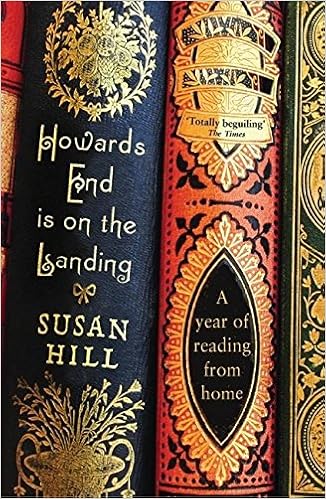
One book of hers that caught my attention a few years ago is Howard’s Is on the Landing: A Year of Reading from Home. She determined one day, when she found a book she had been looking for in a pile on the landing, that she would spend one year only reading books already in her home. It’s a lovely book, and a wonderful exploration of books she’s loved (and not loved so much) over the years. I was totally intrigued by this process, and briefly considered trying it myself. I just might do that one of these years!

She has a sequel to Howard’s End Is on the Landing coming out in October, Jacob’s Room Is Full of Books. I’ll look forward to reading this edition as well.

You can learn more about Susan Hill at www.susanhill.org.uk.


Magpie Murders

For those of you who follow British TV mysteries, Anthony Horowitz wrote many of the episodes of the ongoing Midsomer Murders, and he is also the originator of the wonderful Foyle’s War. He also wrote the novel Moriarity, a wonderful reprise of the Sherlock Holmes stories from an interesting perspective.

A couple months ago I read a new novel of his, Magpie Murders. It is a very good book –  a mystery within a mystery. An editor is reading the manuscript of a new novel by one of the publishing house’s major income streams, and the book includes a report on another mystery that becomes part of the whole plot. And the new manuscript is missing the last chapter! And then the author dies. So it is multiple layers of mystery, detectives, victims, perpetrators, and complication upon complication.

The book is also very funny, with an interesting assortment of character names that become part of the resolution of both mysteries. Keep Google nearby as you read so you can check out the real places and real historical events. A very fun book!

Magpie Murders: A Novel by [Horowitz, Anthony]

Sharing Books

One of the best parts of owning books is sharing them. I’ve always enjoyed that, especially if it’s a book I really like and the person with whom I share it really likes it, too! But the problem is that I often forgot who has the books I lent, and then I go looking for them and wonder where they are.

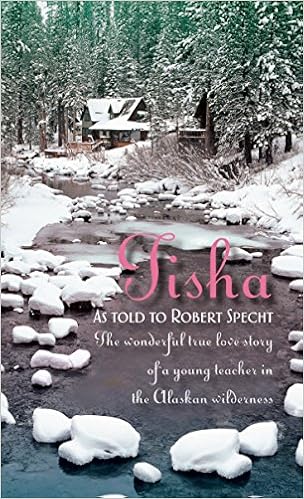
My almost 102 year-old aunt has always enjoyed reading. It’s hard for her hold a book now, and her care-givers read to her. So sometimes I think of books she might enjoy and take them to her. She was an elementary school teacher, so I thought she might like a book called Tisha. It’s the story of a young (19) year-old teacher who ventures into Alaska in 1927. It’s a true story that was told to the author, Robert Specht. Tisha teaches in Chicken, Alaska, east of Fairbanks near the border with the Yukon Territory. It was named “Chicken” because the couple of miners who settled there saw a lot of ptarmigans running around and thought they were chickens! It’s a sweet story, well-written, and very revealing about the conditions and attitudes of the time. The teacher’s name was Ann Hobbs and her courage, commitment, and curiosity make her story a great (and fast) read.

So I’ve been looking from time to time for this book in various places in our house, and I cannot find it. I loaned to someone sometime. I hope it has continued to be shared with others. Who knows? Maybe I loaned it to my aunt years ago, and it’s somewhere in her house. When you’re almost 102 you can’t remember what you’ve read or not read, so every book is a new adventure!

I recommend Tisha as a new adventure for all of you!


Going to Three Pines

On the very warm evening of August 29, my husband and I joined 1000 other people (mostly women over 60, as it turned out) at University Methodist Temple to hear author Louise Penny. (See my post of January 4.) It was the day of publication for the 13th novel in the series about now Chief Superintendent Armand Gamache of the Sûreté du Québec, Glass Houses.

Penny is a charming and compelling speaker, and her fluid descriptions of her writing process kept us all attentive and ready for more. Her husband died about one year ago, and she shared her life with and without him in a way that included us without being overly personal. It was really fun to hear her talk about how the people of the village in which she lives are indeed the characters in her books who inhabit Three Pines, the Brigadoon-ish village of the novels. Three Pines is the place where we all want to live (certainly exhibited by the attendance Tuesday night), and it has the same imperfections as the places where we all live now.

Penny stressed the community of Three Pines. She said that if she had any theme or vision she wanted to portray in these books it is that of community’s importance. Even as a writer, she could not do it without the community of villagers and friends surrounding her. And she said her year of loss could not have been sustained without such community, especially as she began writing this book as her husband was dying and in these following months. She said that Three Pines is her safe place, and she goes there each day when she sits down to write.

I invite you to go to Three Pines, starting with the first novel, Still Life. You can get the whole list at her website: www.louisepenny.com, and follow her on Facebook. The New York Times occasionally interviews authors in a feature called “By the Book,” and they interviewed Penny a week ago: https://www.nytimes.com/2017/08/24/books/review/louise-penny-by-the-book.html?action=click&pgtype=Homepage&version=Moth-Visible&moduleDetail=inside-nyt-region-0&module=inside-nyt-region&region=inside-nyt-region&WT.nav=inside-nyt-region&_r

And yes, this blog is back!