Neverwhere

Every year my husband and I go to a wonderful remote town on the west coast of Vancouver Island called Tofino. We love the beach, the culture, the quiet of this lumber, fishing, and tourist destination. There’s also great food everywhere.

One thing we always do is stop in at the local bookstore, Mermaid Tales. It’s an excellent shop and we always find new and interesting reads. I discovered Iona Wishaw there (see a previous post about her wonderful mysteries) and this time my husband discovered Steve Burrows’ Birder Mysteries. He hasn’t come up for air yet!

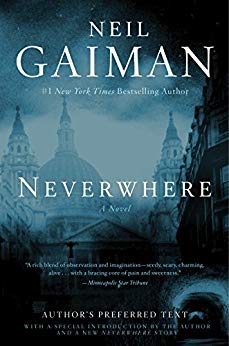
On this October trip I picked up Neverwhere by Neil Gaiman. I’ve enjoyed his Norse Mythology, so I thought I’d give this a try. I do enjoy fantasy, but with limits, but as this is set in London I figured it would work!

It is a very interesting conceit, with a “London Below” and a “London Above.” Gaiman uses an old map of London’s Tube, locating many of the stations that no longer exist. For example, there used to be a British Museum station. Looking at the description on a map and in a Wikipedia article, I don’t know that it would get you any closer than the current High Holborn and Russell Square stops, but it’s interesting to know that London’s Tube has shifted and changed with the years. The characters and locations in “London Below” all relate to Tube stops. For example, there is an angel named Islington. Angel is a Tube stop in the Islington area. He also makes use of London’s underground rivers, as have writers Christopher Fowler (Bryant and May) and Anthony Horowitz. (You can read about them in my previous posts.)

Neverwhere is a kind of frightening tale of one young man, Richard Mayhew from “London Above,” who gets drawn into “London Below” when he stops to help an injured young woman on a London street. Her name is Door, and he follows her to look for a door that will help save her life, and that of many others. There are some really creepy evil people in this book, but the fantasy part holds extremely well. Although I wasn’t sure at the beginning if I would stay with it, the story line totally hooked me and I had to finish to find out what happened! I wasn’t totally surprised by the ending, although it is, in many ways, surprising.

As we approach Halloween, if you want to read a nice, creepy, intriguing fantasy, I recommend Neverwhere. (N.B.: The story about the book is as interesting as the book itself!)
Fell Murder by E.C.R. Lorac

A few years ago The British Library started reprinting mysteries from what’s called The Golden Age of Detective Fiction. This is largely assumed to be the 1920’s and 1930’s, mostly in England but there are titles elsewhere. I’ve enjoyed reading these and meeting new and wonderful writers in a genre and a time I greatly appreciate.

I just finished Fell Murder by E.C.R. Lorac, the pen name of Edith Caroline Rivett, who also wrote as Carol Carnac. (Note that “E.C.R.” are the initials of her real name, and “Lorac” is “Carol” spelled backwards.) It’s a novel written at the height of her career and is set in Lunesdale, Lancashire, where she had moved from London in 1950’s. The story is in the waning years of World War II (it was published in 1944) and reflects some of the still active parts of the home requirements: total blackouts at night, and the main farm, Garthmere, has a land girl (Elizabeth, called Lisa) working. Lorac weaves an interesting, complicated, and inevitable tale. The detective from London, Inspector MacDonald, Lorac’s usual, is a calm, even, experienced policeman. Learning to follow his pathway is part of the fun of this book.

The real joy in this one is Lorac’s splendid writing about the landscape. She deftly portrays the beauty of Lancashire, and it is clear she deeply loved her adopted home. I learned a lot of new words like “stirk” and “shillon,” and the descriptions of daily farm work are wonderful. One of the fun parts of it all is the interest MacDonald takes in the farming, often musing how he’d like to leave London and become a farmer in Lancashire. I don’t think she farmed, but I’m sure MacDonald’s longings match those of his creator.

Zadie Smith: In Defense of Fiction

Zadie Smith is a wonderful writer. I was first introduced to her in a sermon preached at St. Paul’s Cathedral, London, a few years ago. The preacher used her descriptions of what it means to write poetry and fiction to help us all understand the miracles in the Gospels. It was a perfect connection, and I have not forgotten it. (I did ask the preacher for his manuscript and he told me there was none! Impressive.)

I had started White Teeth once and did not get far, but I really liked On Beauty. And Smith continues to write about writing and about the relationship between reader and writer and the place of fiction in our culture.

The current issue of The New York Review of Books has an amazing essay by Zadie Smith titled “In Defense of Fiction.” This is a long and complex piece, but well worth your time.

http://www.nybooks.com/articles/2019/10/24/zadie-smith-in-defense-of-fiction/