As noted above, I am a big fan of the reader’s quarterly, Slightly Foxed. They also have a wonderful podcast, aired every month on the 15th. This December one is just fabulous, and I commend it to you. It’s called Vital Spark, and you’ll find it at www.http://www.foxedquarterly.com under podcasts.
Author Archives: theincompletereader
The Long Call by Ann Cleeves
I know I am among a host of readers who lamented the end of Ann Cleeves’ series of mysteries set in the Shetland Islands. But there is hope for the future! I recently finished her first book in a series set in North Devon. The book enters interesting territory with a married gay detective in a small community, the remnants of a conservative Christian sect, and all the usual challenges of a police force trying to make its way in our difficult and complex world. As in her other novels, she beautifully merges the mystery and detection with the personal lives of the characters. We get to know Detective Matthew Venn pretty well by the end of the book, and we’re happy to make his acquaintance!
As I did with the Shetland mysteries, I find myself checking maps as much as anything. The part of North Devon where she sets this – in and around Barnstaple – is beautiful and interesting. Like many parts of England, there are rivers and the perpetual sea, offering lots of places to discover bodies and hide secrets!
I’m looking forward to the next book in the series, and I highly recommend The Long Call. (N.B.: I’ve only watch Vera on television, so at some point I’ll get to read Ann Cleeves’ Vera series!)

Neverwhere
Every year my husband and I go to a wonderful remote town on the west coast of Vancouver Island called Tofino. We love the beach, the culture, the quiet of this lumber, fishing, and tourist destination. There’s also great food everywhere.
One thing we always do is stop in at the local bookstore, Mermaid Tales. It’s an excellent shop and we always find new and interesting reads. I discovered Iona Wishaw there (see a previous post about her wonderful mysteries) and this time my husband discovered Steve Burrows’ Birder Mysteries. He hasn’t come up for air yet!
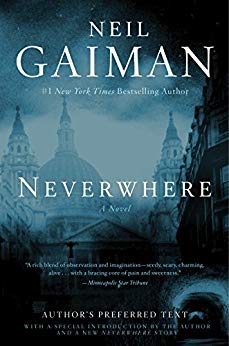
On this October trip I picked up Neverwhere by Neil Gaiman. I’ve enjoyed his Norse Mythology, so I thought I’d give this a try. I do enjoy fantasy, but with limits, but as this is set in London I figured it would work!
It is a very interesting conceit, with a “London Below” and a “London Above.” Gaiman uses an old map of London’s Tube, locating many of the stations that no longer exist. For example, there used to be a British Museum station. Looking at the description on a map and in a Wikipedia article, I don’t know that it would get you any closer than the current High Holborn and Russell Square stops, but it’s interesting to know that London’s Tube has shifted and changed with the years. The characters and locations in “London Below” all relate to Tube stops. For example, there is an angel named Islington. Angel is a Tube stop in the Islington area. He also makes use of London’s underground rivers, as have writers Christopher Fowler (Bryant and May) and Anthony Horowitz. (You can read about them in my previous posts.)
Neverwhere is a kind of frightening tale of one young man, Richard Mayhew from “London Above,” who gets drawn into “London Below” when he stops to help an injured young woman on a London street. Her name is Door, and he follows her to look for a door that will help save her life, and that of many others. There are some really creepy evil people in this book, but the fantasy part holds extremely well. Although I wasn’t sure at the beginning if I would stay with it, the story line totally hooked me and I had to finish to find out what happened! I wasn’t totally surprised by the ending, although it is, in many ways, surprising.
As we approach Halloween, if you want to read a nice, creepy, intriguing fantasy, I recommend Neverwhere. (N.B.: The story about the book is as interesting as the book itself!)
Fell Murder by E.C.R. Lorac
A few years ago The British Library started reprinting mysteries from what’s called The Golden Age of Detective Fiction. This is largely assumed to be the 1920’s and 1930’s, mostly in England but there are titles elsewhere. I’ve enjoyed reading these and meeting new and wonderful writers in a genre and a time I greatly appreciate.
I just finished Fell Murder by E.C.R. Lorac, the pen name of Edith Caroline Rivett, who also wrote as Carol Carnac. (Note that “E.C.R.” are the initials of her real name, and “Lorac” is “Carol” spelled backwards.) It’s a novel written at the height of her career and is set in Lunesdale, Lancashire, where she had moved from London in 1950’s. The story is in the waning years of World War II (it was published in 1944) and reflects some of the still active parts of the home requirements: total blackouts at night, and the main farm, Garthmere, has a land girl (Elizabeth, called Lisa) working. Lorac weaves an interesting, complicated, and inevitable tale. The detective from London, Inspector MacDonald, Lorac’s usual, is a calm, even, experienced policeman. Learning to follow his pathway is part of the fun of this book.
The real joy in this one is Lorac’s splendid writing about the landscape. She deftly portrays the beauty of Lancashire, and it is clear she deeply loved her adopted home. I learned a lot of new words like “stirk” and “shillon,” and the descriptions of daily farm work are wonderful. One of the fun parts of it all is the interest MacDonald takes in the farming, often musing how he’d like to leave London and become a farmer in Lancashire. I don’t think she farmed, but I’m sure MacDonald’s longings match those of his creator.

Zadie Smith: In Defense of Fiction
Zadie Smith is a wonderful writer. I was first introduced to her in a sermon preached at St. Paul’s Cathedral, London, a few years ago. The preacher used her descriptions of what it means to write poetry and fiction to help us all understand the miracles in the Gospels. It was a perfect connection, and I have not forgotten it. (I did ask the preacher for his manuscript and he told me there was none! Impressive.)
I had started White Teeth once and did not get far, but I really liked On Beauty. And Smith continues to write about writing and about the relationship between reader and writer and the place of fiction in our culture.
The current issue of The New York Review of Books has an amazing essay by Zadie Smith titled “In Defense of Fiction.” This is a long and complex piece, but well worth your time.
http://www.nybooks.com/articles/2019/10/24/zadie-smith-in-defense-of-fiction/
Banned Books Week, 2019
For those of us who love to read and love to recommend and encourage reading for everyone, it’s almost impossible to think of banning anyone from reading books. But thus it has been throughout history, and it will sadly continue in many areas of our country and the world. The people who are so frightened of what their children (or others) might encounter in the written word must really know the power of that word.
In this Banned Books Week I could, I suppose, recommend dystopian novels like Ray Bradbury’s Fahrenheit 451 and even Margaret Atwood’s The Handmaid’s Tale. But the imaginative wonders of fiction in any form are enough to celebrate this week, and this article from the September 23, 2019 New York Times says it all so well: https://www.nytimes.com/2019/09/23/opinion/banned-books-harry-potter.html
The Winter Soldier by Daniel Mason
The book group in which I participate chose this book for our end-of-summer read. I hadn’t heard of it, but I was engrossed from the very start. Set during World War 1 in that amorphous national boundary land in Eastern Europe – Poland, Ukraine, Slovakia, Hungary, Austria – it follows the journey of a dedicated medical student who finds himself working as a doctor in an improvised hospital in a small town church in the Carpathian mountains.
This is not an easy book to read. The author, who is a physician, spares no details about the horrific injuries and treatments of the time. Perhaps the most horrifying is the authoritarian and brutal methods of conscription in the various armies. I say “various” because no one really knows with whom they are fighting or who the enemy is. This area of the world is so complicated, and the somewhat new national boundaries at the beginning of the 20th century do nothing to block or hold the old ties of tribe and language. In fact, language is an interesting feature of this book, as the doctor (fluent in Polish and German) has to negotiate soldiers speaking Hungarian, Czech, and the local Ruthvenian.
The vocabulary of this novel is large and wide-ranging. I went to the dictionary often to check on a medical term or a word usage with which I was unfamiliar. For me, this added to the depth and richness of the book.
The story follows the doctor Lucius as he learns and grows into adulthood, with a fascinating love story woven in. I love the layers of individual meaning and discovery that frame the plot and lead to its somewhat surprising but totally sensible ending. This is a great read!

A Better Man
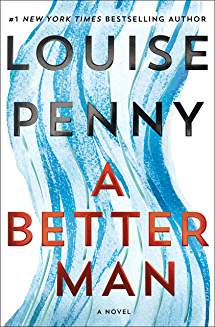
Louise Penny’s long-awaited new addition to her Armand Gamache novels explores its title in a variety of ways. As with the other stories, the novel’s crime detection plot is almost secondary to the matters of personal growth and relationship. The main story focuses on a lost woman who maybe isn’t lost. While the Quebec Sûreté determines if the case is worth pursuing, they are surrounded by the force of nature that is a sudden Spring thaw. Penny does a marvelous job describing the heaving ice and rushing water that makes the situation so dangerous. Even though we know it is so early in the book that, even when it get scary and harrowing, our heroes will survive, her descriptions make you sit up straight and pay attention.
The rest of the story unfolds from there, with the missing woman found dead in the frigid, rushing water. The story makes its way through the lives of the dear residents of Three Pines, the lives of the officers of the Sûreté, and the lives of Gamache and his family. A sinister theme throughout is the real hatred for Gamach among the political leadership of Quebec. There the solid, yet vulnerable, character of Armand Gamache comes out best. I wonder if he is “The Better Man?” There are other potential candidates! The whole story is an interesting exploration of what makes for character in each person and in relationship.
For a while I thought this novel would be too much about the lives of the characters, and especially about Gamache’s issues with the powers that be and with his own return to the force. But at the end I felt that Penny has really done a marvelous job drawing us into the multitudinous foibles of humanity and what we all can do to be “better” ourselves.
Books and Travel, Part 7: Orkney and George MacKay Brown
This trip has a had a lot of ferries, which makes me very happy indeed! We took the ferry from Kennacraig to Islay and back again, then from Oban to Mull and back again. After we got to the top of Scotland, making the obligatory drive out to Dunnet’s Head, the farthest north point of the UK (it’s not John o’Groats!), we took the ferry from Scrabster by Thurso to Stromness on Orkney. We happily drove to our B and B, the Mill of Eyrland, following the wonderful directions of our host past the red phone box in field! It is a great place, and we had lovely, comfortable rooms in a refurbished mill. Fascinating. We sipped scotch each night in the guest lounge surrounded by the old millstones and equipment! Our host Morag and her partner John were delightful, and Morag kept us well-informed about life on Orkney.
Orkney is wonderful and we so enjoyed our time. Visiting the Neolithic ruins such as Skara Brae, many rings of standing stones, and the mound of Maeshowe helped us place ourselves in the long and ancient length of human history. We learned a lot.
The islands of Orkney are low and flat, surrounded by the sea, and covered in North Ronaldsay sheep, their unique type. Morag works for the office of Economic Development, so she could tell us that there are 21, 160 people on Orkney. She noted that many of the houses have only one occupant. Houses and farms are dotted through the landscape with sometimes great distance between them.
Orkney has a famous distillery, Highland Park, and we stopped in. We did not do the tour, but we bought some whisky to enjoy along the way!
The connection with the Vikings and with Norway are prevalent everywhere. Some say the Orcadians sound more like Scandinavians than Scots, but I think it’s a toss up. Their local saint is Magnus, for whom their cathedral in Kirkwall is named. His bones are buried in one of the pillars, and there is a now a posted St. Magus Way which follows an ancient pilgrimage from Birsay to Kirkwall. Magnus was killed in Birsay, and his mother arranged for his body to be carried to Kirkwall for burial,. The path follows his funeral route. Magnus was a grandson (not the legitimate line) of Olaf II of Norway, St. Olaf.
Although the various relatives of Robert Louis Stevenson pop up all over Northern Scotland, even in Orkney, Orkney’s most famous writer in George MacKay Brown (1921-1996). He lived most of his life in Stromness and wrote poetry, novels, short stories, and essays. I have only read his autobiography For the Islands I Sing. It is a compelling and lovely book. [Note: the Slightly Foxed Podcast for September (comes out on the 15th) will be about Orkney and George MacKay Brown. See Books and Travel, Part 4, for the link.]
We left Orkney by the other ferry, St. Margaret’s Hope to Gills Bay. We were sad to leave it behind, and we had a beautiful morning to watch it as we sailed south.
Books and Travel, Part 6: The North Coast 500 and Blue Guides
We unwittingly drove a currently very popular route known as The North Coast 500. It starts and ends in Inverness, and just follows the whole coastline all around the north of Scotland. We just passed by Inverness coming and going, but we certainly did the whole route.
Travel guides and touted routes are interesting things. When I was a kid, we always went on car camping trips in the summer all over the west. We used the trusty AAA Accommodation books to find places to camp and also motels from time to time. I still remember how much fun it was to determine a destination with my parents and then look in the book to see what we could find. If it was a motel with a swimming pool, that was the best!
The whole travel guide industry had certainly expanded, but having guides is as old as traveling. The Baedeker guides of the later 19th – early 20th century were the indispensable companions for the wealthy traveler of their era. My favorites of the 20th century were the Blue Guides. I still have a few, and we actually brought our 20-year old Scotland Blue Guide with us on this trip and it’s been very helpful. These guidebooks were first published in 1918, and they published the English versions of Baedeker. These guides are still being published in various forms, and you can read more about them here: https://www.blueguides.com/ I love them for their detail on every single thing, and so enjoy reading the little things about a town or a person that I would never have discovered any other way.
In the 19th and 20th centuries you might have seen travelers with a red Baedeker or a blue and white Blue Guide as you traveled around. These days in Europe its likely to be Rick Steves’ blue and yellow books, or a well-work copy of a Rough Guide, a Lonely Planet, or a DK visual guide. And the internet provides access to information that could only have been dreamed of before. But being guided into new places and adventures is the whole purpose of guidebooks, and they are good to have in any form.
Our North Coast drive brought us to the small community of Dundonnel on a beautiful loch in a lovey B and B. Gaelic was spoken around us, as was something from Eastern Europe, showing again the great links across cultures we have where we live and where we travel.
 The Incomplete Reader