For this Feast of the Epiphany, a listen (and read if you wish) to T. S. Eliot’s The Journey of the Magi.
Monthly Archives: January 2018
The Twelfth Day of Christmas Books
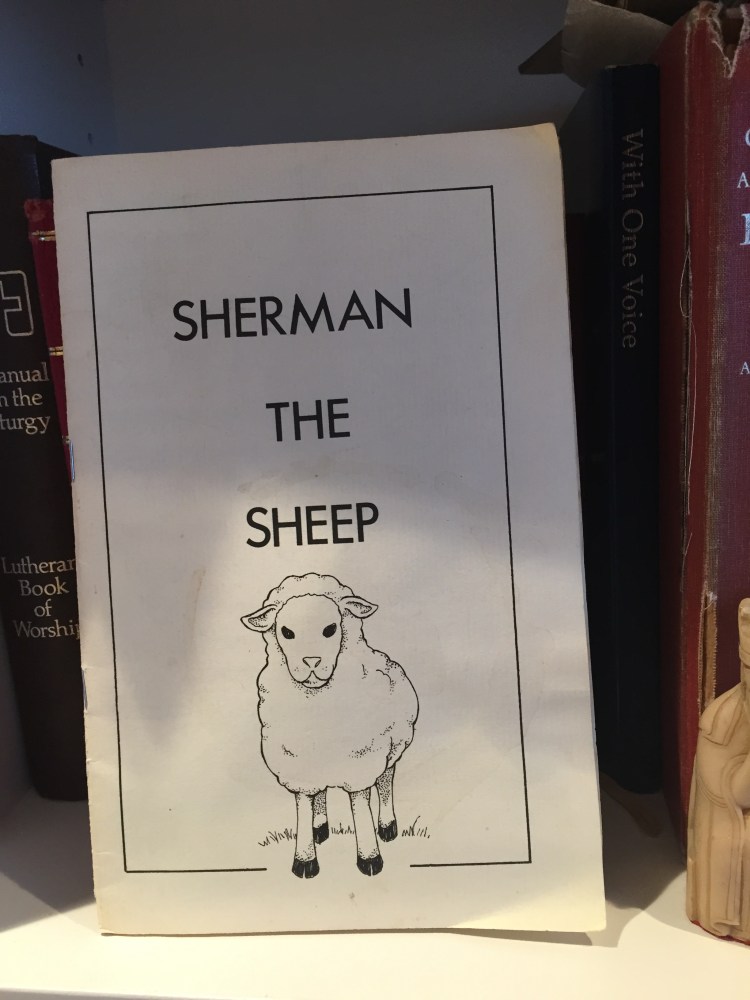
The first year I was a parish pastor, at Holden Village in the North Cascade mountains of Washington State, I thought I should tell a story to the children as part of the Christmas Eve service. I don’t remember exactly what that story was – I think it had to do with a cat – but I did continue to create a story each year wherever I was. In my third Christmas at Faith Lutheran Church in Seattle in 1983 I wrote a story about a sheep named Sherman. The next Fall, the parish children started coming to me asking, “Pastor Winder, Pastor Winder, is Sherman coming to Christmas again?” So every year for 25 years I told a new story about Sherman. They were collected from time and time and published in the congregation, with delightful drawings by Rebecca Rickabaugh, a friend of Faith members Sandi and Bob Dexter. So this Twelfth Day celebrates Sherman the Christmas Sheep with the first story from 1983.
For the Animals, Too.
In that region there were shepherds living in the fields, keeping watch over their flock by night. Luke 2:8
You know the story. Angels appeared in the sky and sang “Glory to God” and told the shepherds to go to Bethlehem and see the baby Jesus. The shepherds were so shocked and excited because of the angels that they went right away, leaving their sheep behind! Now the sheep had seen and heard the angels, too, and they were very surprised when the shepherds ran off without them. One sheep, whose name was Sherman, said, “I think we should go to Bethlehem.” Another sheep said, “No, we’d better stay here. The shepherds will be angry if we go there.” And another said, “It’s cold and dark and way past the lambs’ bedtime. I’m scared. Let’s all stay here.” And another sheep said, “This is a people event. They don’t want animals.” But Sherman said, “We all heard the message of the angels. They said this was peace for all the earth, and sheep are about as earthy as you can get. I am going to Bethlehem.” So Sherman started down the hillside. Many of the sheep went with him, but others stayed behind with the lambs.
When they got to the road, they were confused. It was very dark. But Sherman said, “I know the way. Come with me.” As the sheep trotted down the road, the dark night became brighter and brighter. There were more stars than ever before, and the moon seemed as bright as the sun. As they came to Bethlehem, they saw a wonderfully huge and welcoming light from an old stable behind an inn. “Come on,” said Sherman. “That is the place!” And the sheep began to run.
When they came to the stable, they stopped suddenly and looked with amazement. There were their shepherds. Some were kneeling and some were standing, but they were all quietly laughing and crying all at once, with looks on their faces like the sheep had never seen before. And there were animals: a donkey, a cow, a lot of birds, a little dog, and a couple of cats. “See!” said Sherman. “I told you it was for the animals!” And they were all looking at the manger where there was a little baby. The baby cried a little, and Sherman realized that it was really very cold in that stable. And then Sherman knew why the sheep had to be there. Silently, he led the other sheep up to the manger. They all gathered round, and Sherman leaned closely into the manger to give the baby Jesus the warm, woolly heat of his body. And the baby stopped crying and went to sleep. And there was never a happier sheep than Sherman was that night.
Story by Nancy L. Winder. Do not reproduce without permission.
The Eleventh Day of Christmas Books
You cannot write about Christmas books without writing about books of songs, hymns, and carols. Each one is its own little narrative, singing the Christmas story in its own unique way.
I grew up with these three carol books, two of which also told stories about the songs. The blue one we often used when groups went caroling in the winter night.


Here is a piece about Joy to the World from The Christmas Carolers’ Book:
“When Isaac Watts published the Psalms of David in 1719, he did not know that had included any Christmas songs in his collection. The Psalms of David was a collection of hymns and paraphrases based on the Psalms. One of these was based on the 98th Psalm, and was entitled, Joy to the World. Watts’ paraphrase, based on neither the New Testament nor the Christmas story, has become one of our greatest Christmas hymns!
Watts, the son of a teacher, and zealous Non-Conformist, of Southampton, preached his first sermon in Mark Lane, London, at the age of 24. His ministry was short-lived. Due to a protracted illness, he was forced to give up preaching. He was then invited into the palatial home of Sir Thomas Abney, where he remained a welcome guest until his death, 35 years later. Watts, himself, said that he had only intended to spend a week at the Abney home. Most of his hymns were writtne while there.
Dr. Watts was a very small man, being scarcely five feet in height. He was in poor health most of his life. His great learning, piety, and gentle disposition, gained for this the title of “Melanchthom of England”. He has been justly called the faither of English hymnody, and shared with Charles Wesley the distinction of being the greatest of English hymn writers. More than four hundred of his hymns are in common use in English-speaking countries. Perhaps his two most famous hymns are, When I Survey the Wondrous Cross, and Joy to the World.
Dr. Edward Hodges wrote an excellent psalm-tune for Watts’ hymn. Dr. Hodges’ tune has been replaced by Lowell Mason’s adaptation of Handel’s Antioch from the Messiah. In spite of its fugue, this adaptation has become the standard setting of the hymn. With the spirited Handel melody, Joy to the World is not only well suited to be used as a church hymn, but is also very effective for outdoor caroling.”
From The Christmas Carolers Book in Song and Story by Torstein O. Kvamme. 1935
The Tenth Day of Christmas Books
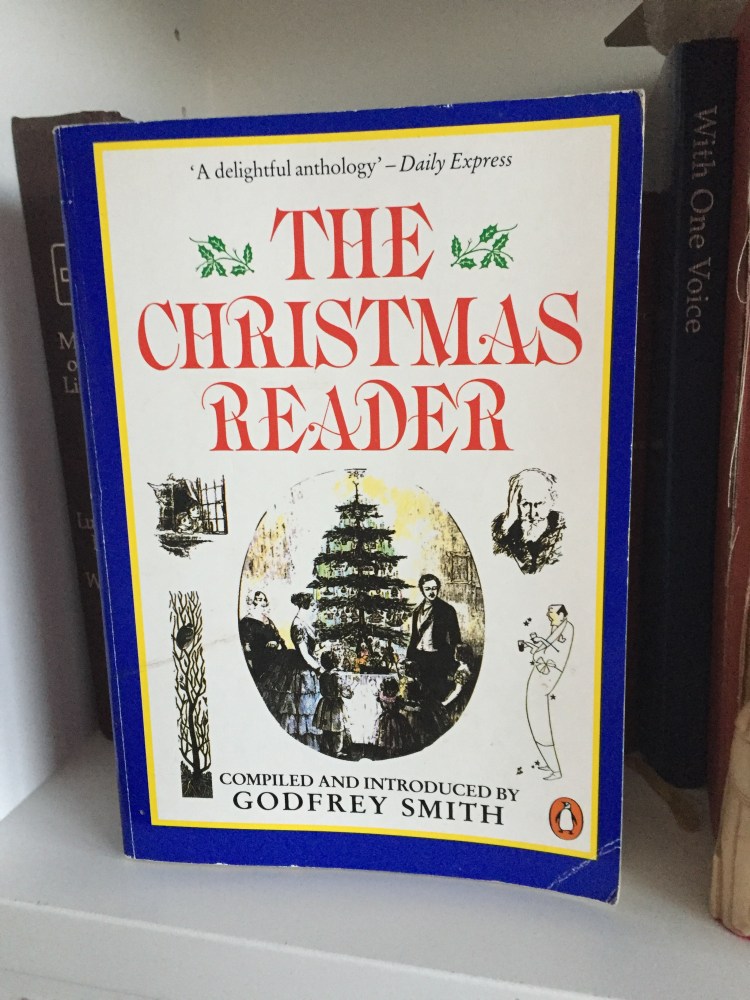
Here is a really good anthology of Christmas stories, poems, and novel excerpts from across the centuries. It is a Penguin edition that appears to only be available in the UK.
The Ninth Day of Christmas Books
I grew up with what a Christmas Annual on the coffee table in our living room. There would be on at my grandmother’s house as well, and in the homes of Norwegian Americans throughout North America. They were first published at the beginning of the 20th century in Norwegian: Jul i Westerheimen (Christmas in Western Homes). The North American immigrants were often referred as in the “Western Homes.” (The Norwegian-American museum in Decorah, Iowa is called “Westerheim.”) The annuals were a way to share the riches of the season and to remember the celebrations of Norway. The books had music, poetry, art, and literature. I remember how much fun it was to look through them and see so many beautiful things. They were marvelously done large (12 x 16 inches) books. It was a good tradition that might be worth resurrecting to show the diversity of today’s world. The one on the left is 1917, the other 1946,


The Eighth Day of Christmas Books
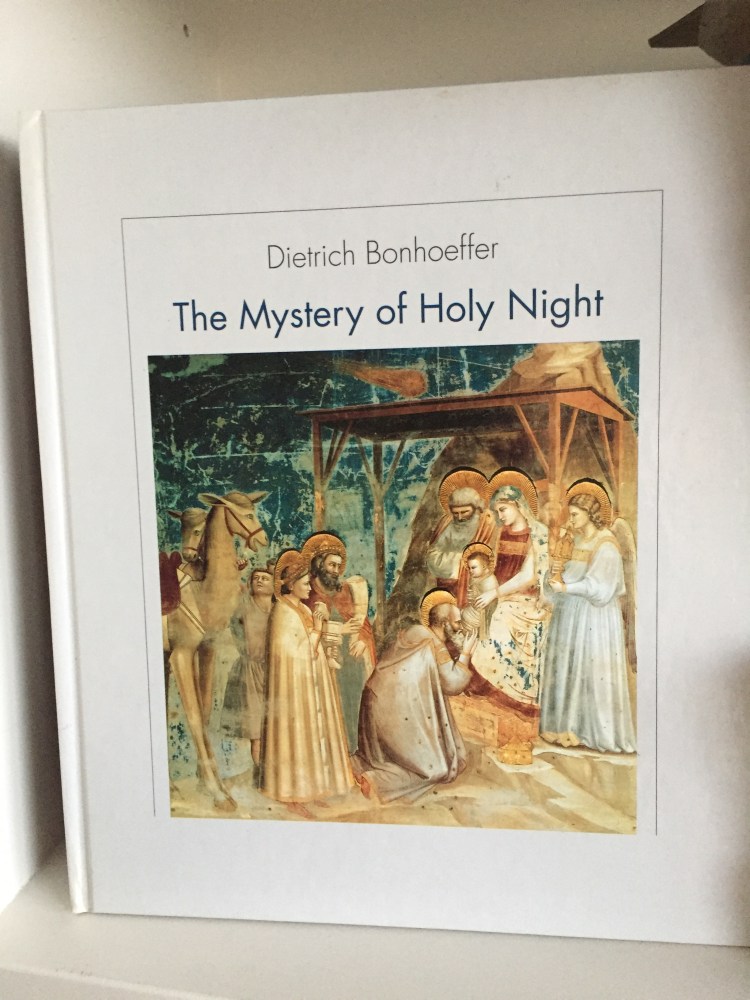
On April 9, 1945, the young German pastor and theologian Dietrich Bonhoeffer was hung by the Nazis for his part in a plot against Hitler’s life. It was just a few days before the end of the war. He had been imprisoned since 1943. Even before his imprisonment Bonhoeffer had already made a significant difference in the life of German Christians in the anti-Nazi Confessing Church. Far from silencing him, his time in prison deepened and enriched his faith and relationships, and so gave us all a gift of understanding who God might be for the modern world. The book The Mystery of Holy Night is a Christmas sermon about the incarnation that draws us into that gift. Bonhoeffer writes: “With God dwells joy, and down from God it comes, seizing mind, soul, and body; and where this joy has grasped a human being, it spreads, it carries away, it bursts through closed doors.”
The Seventh Day of Christmas Books
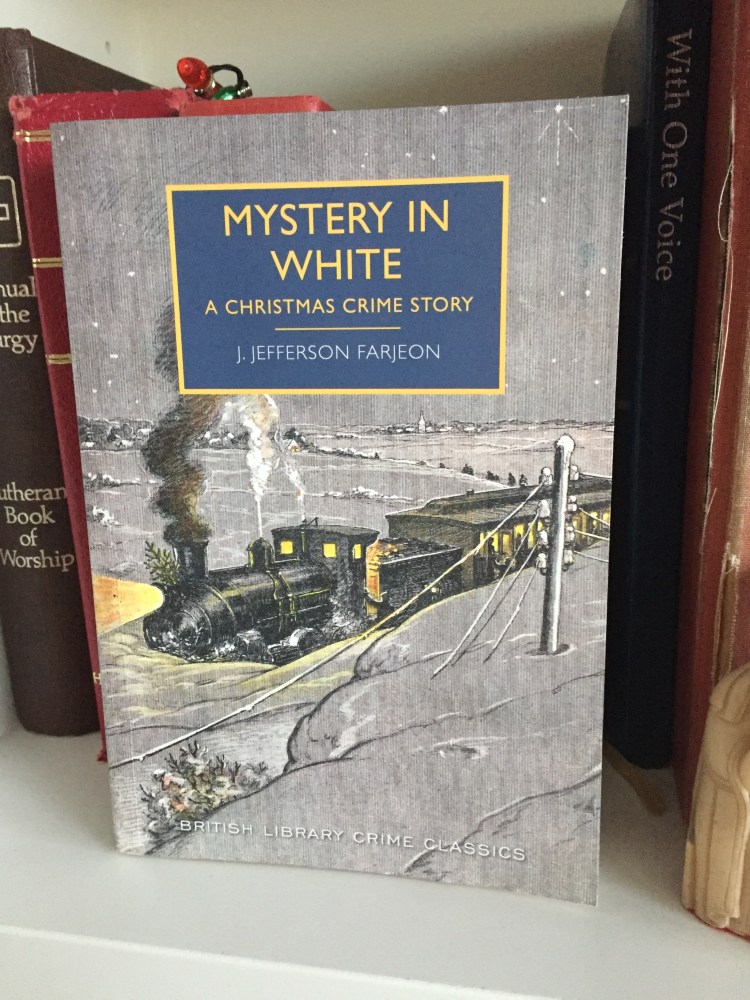
And even more mystery! The British Library has been publishing crime and mystery novels from the 20th century that had gone out of print. They are all quite wonderful and I commend the whole series to you. One is titled Mystery in White – A Christmas Crime Story by J. Jefferon Farjeon. It’s a story not unlike Murder on the Orient Express. (If you have not seen the excellent new Kenneth Branagh movie on Agatha Christie’s great novel, be sure and do so soon!) In Mystery in White, a heavy snowfall brings a train to a halt near a small village, and the passengers all find shelter in a deserted country house, and it all plays out from there.
Although not well known today, Jefferson Farjeon’s work was highly regarded in his day. Dorothy L. Sayers wrote that he was “quite unsurpassed for creepy skill in mysterious adventures.” A lovely Advent/Christmas connection here is that he was the brother of Eleanor Farjeon who wrote the text for the Advent hymn People Look East. She also wrote the much more famous Morning Has Broken. You can learn more about the Farjeons on Eleanor’s Wikipedia page: https://en.wikipedia.org/wiki/Eleanor_Farjeon
 The Incomplete Reader